Returning Home to Borno
Nearly 200 years after my family was carried out as slave, I returned home to the Kanem-Borno empire.
Posted: 2025-Jul-03
I last visited Borno State in 2008, when I conducted anti-human-trafficking training for all Government of Nigeria personnel posted to the border crossing with Chad at Gambaru Ngala. The conflict with Boko Haram commenced in July 2009, from which time travel to Borno State has been impossible for me to even contemplate. I will be forever grateful to have had the privilege of traveling freely to and within Borno State prior to the civil conflict. The "home and family" I found there in 2008 have almost certainly been devastated at best, and destroyed at worst.
Email to Family | December 2006
Arriving in Kanuri-land: Maiduguri
I have finally made it to Maiduguri, Borno State, which is the main city in Kanuri-land here in northeast Nigeria. It is near the border with Cameroon and Chad, and is close to Lake Chad. Until a few decades ago, the border with Cameroon was the river that bisects Maiduguri. This is the area to which we likely trace through Christiana's line.
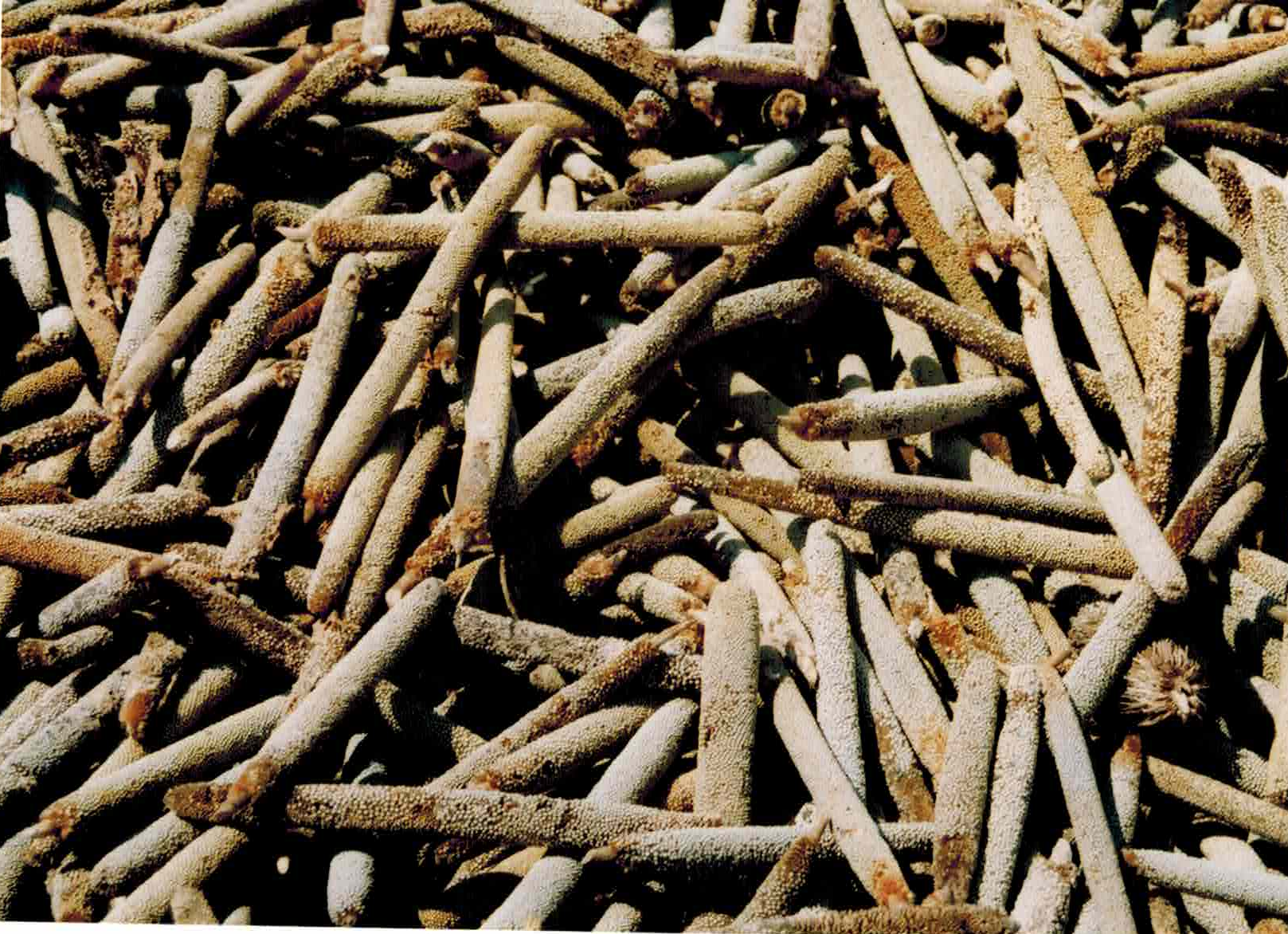
I am rather at a loss of words to describe Maiduguri or what it means to be here. I suppose I should at least start by saying it is a desert here. They get about 2.5 months of rain a year, and in much less quantity than Abuja or Lagos. They grow maize, beans, a little rice, and grain that my friendly taxi driver did not know the English name for. It grows on a stalk similar to corn but much thinner and shorter. The ear and kernels are also small . . . almost looks like a cat tail. It is very tasty even freshly threshed, with a nutty flavor. They raise a lot of cattle and goats here. There are not many varieties of trees that survive here, one being an ornamental tree imported from India. It doesn't really look like Kenya here, but more so than the rest of Nigeria. The town has reasonably wide streets in parts of town, and narrow ones where it matters at the central market. Other than the paved roads, everything is dirt. The dirt is a grayish brown.
Exploring Beyond the City
Today I had the taxi take me to two places outside of Maiduguri. The first was a reasonably good sized town about an hour away to the East. It was maybe the size of Toquerville 20 years ago. That was on the main highway to the border with Cameroon, so there was a fair amount of traffic, even if the road was pot-holed pretty good. It was a nice trip, but I was a bit disappointed in that I wasn't finding what I was searching for.
We came back to Maiduguri then set off north of Maiduguri but only 20 miles or so. This was a very rural area, with a road to match. We reached the end of the road to find a very small town with traditional huts, which was nice, but the really interesting stuff happened a few miles before reaching the town.
Threshing a Traditional Grain
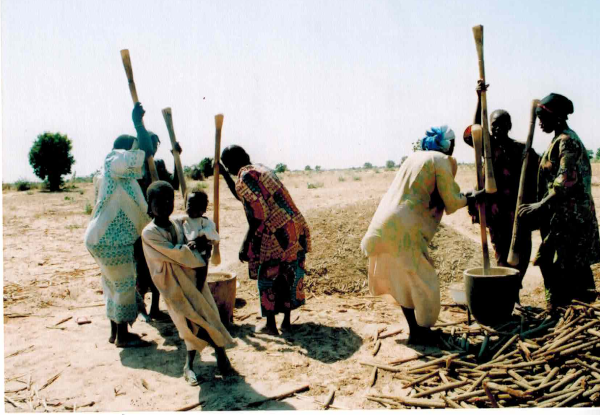
As we were heading towards the town, I noticed a group of women threshing grain using mortar and pestle (I think that is the right word). In any event, it means a hollowed stump in which they put the head of the grain that I don't know the name, and three women stand around it each pounding in turn with a log about 5 feet long and the size around of an arm. I asked Yunusa (the driver) to stop, and we went to ask if I could take their snap (photo). They spoke Kanuri and no English, so Yunusa translated (I only understand about half of what he says anyway). They were very gracious and willing to show me the grain and how they pounded it. They were quite happy to let me take their snaps. There were 6 women pounding in two mortars, and another 2 or 3 who were gathering the ears from the pile to put into the mortar. They had several children sitting under the shade of a nearby tree.
Building a Home: Kanuri Huts
As we left the women, we came to their small small village (not the "main" town at the end of the road) about a kilometer down the road. The houses were traditional huts, and the men were re-building one of them. We didn't stop going, but on the way back from the "town," I had Yunusa stop. We asked if I could watch them and take snaps as they worked on the huts. They were very gracious and willing to show me their homes and how they build them. Yunusa said it was unusual for them to show me, as they generally would not allow someone into their home.
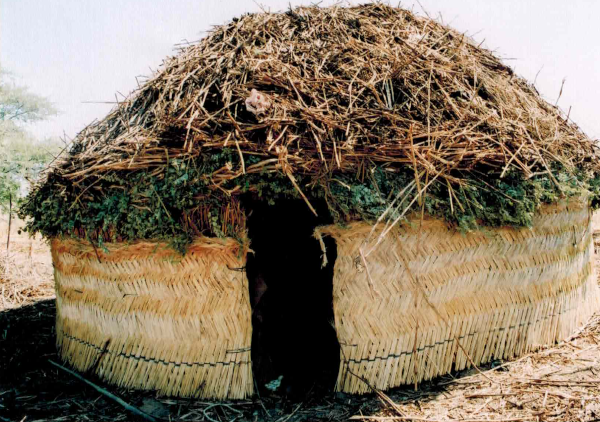
The huts are round and large, maybe 15 meters diameter, and have a framework of posts for the walls and roof. The walls are covered with woven grasses and are about 5 feet high. The roof then slopes to the center pole about 10-12 feet high. At the junction of the walls and roof, they use brush that looks a bit like sage brush to seal the joint against the rains. On top of the roof, they pile the stalks of the grain that I don't know and then cover that with large sticks to help secure it. It is an interesting way to thatch the roof, but they don't have the fine grasses to thatch with that other places in Africa do (Zambia has beautiful thatching on traditional huts). There was one mud hut in the compound, which was the chief's. The grass/pole/thatch huts were similar to those in Turkana in Kenya.
In the village, they were spreading to dry the grain I don't know after they had threshed it again and washed it. Apparently, they make an alcoholic drink of it as well as prepare it as food in several ways. It is a grain that only the Kanuri use, and it is the staple of their diet. I had not seen anything of it in Abuja.
Finding What I Needed
I think this village is about as close as I will find to what life would have been like 200 years ago here around Lake Chad. It was what I had hoped to find on this trip to Maiduguri. There is so much we still don't know, but the one thing I can say about being here is that I just feel completely comfortable and peaceful. I wish I could say it better, but I really am at a loss of words. It is very different for me than when I was at St. Pancras Church in London [Where Christiana married Luke], but I have found in each place what I needed to find.
Related Posts
Calabar’s Ghosts: Tracing My Family Through a Slave Port (pt 1)
Calabar and the Weight of Chains (pt 2)